Large Blue is a Close and Remote (Sophie Mellor and Simon Poulter) project for Brigstow Institute at the University of Bristol. Our brief was clear but challenging. How to engage academics and activists in a conversation about the personal and planetary in the age of climate change. Our immediate thoughts were to get people out of the university and into places that might open up dialogue and debate.
We had studied the story of the Large Blue, reintroduction in Somerset. If you don’t know the story then you can click to read it here. In choosing two locations, plus a visit to Bristol Museum, we knew that we would make some kind of film but this process remained open. A natural collaborator fell into place, Jon Dovey – someone with an enquiring mind and a roving eye. Jon also became the sound recordist. We shot the film on iPhones (with some gimble work naturally).
Collard Hill, on the Polden Hills in Somerset, is a publicly accessible location where the Large Blue butterfly has been successfully reintroduced. Over a series of visits, we acquainted ourselves with this idyllic place. It took a while to understand just how much conservation and human intervention is needed to reintroduce a butterfly. Gradually, we understood the need for wild flowers (thyme), shorter grassland and Myrmica sabuleti ants. Large scale farming has destroyed this kind of habitat across England.
We also chose Aust Motorway Services as a location to take our groups of academics and activists. We hoped for the same group at all of the locations, including the museum visits, but this was somewhat naive with busy diaries. Aust was a challenge location, imagining a post-carbon future or re-use of the original 1966 services.
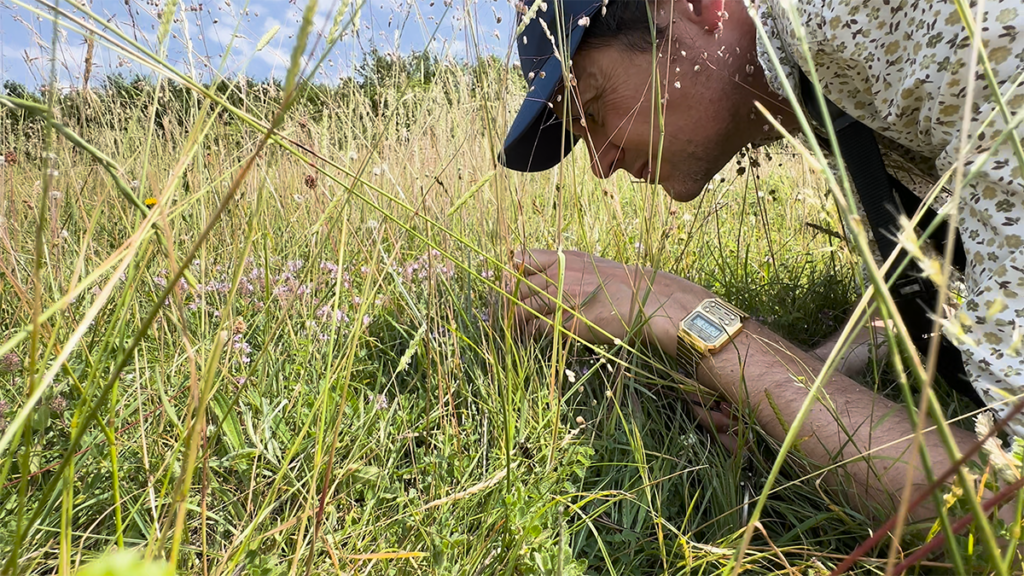
Nearly all Close and Remote projects have moments of opportunity, where we push for something a bit different. In this case Simon had been talking with Patrick Barkham about his new book on Roger Deakin. We decided to invite him to be an unexplained guest at out Collard Hill trip. In fact, as it turned out, Patrick was able to take the idea of ‘close looking’ to a new level, as he gleefully searched for Large blue eggs on Collard Hill.
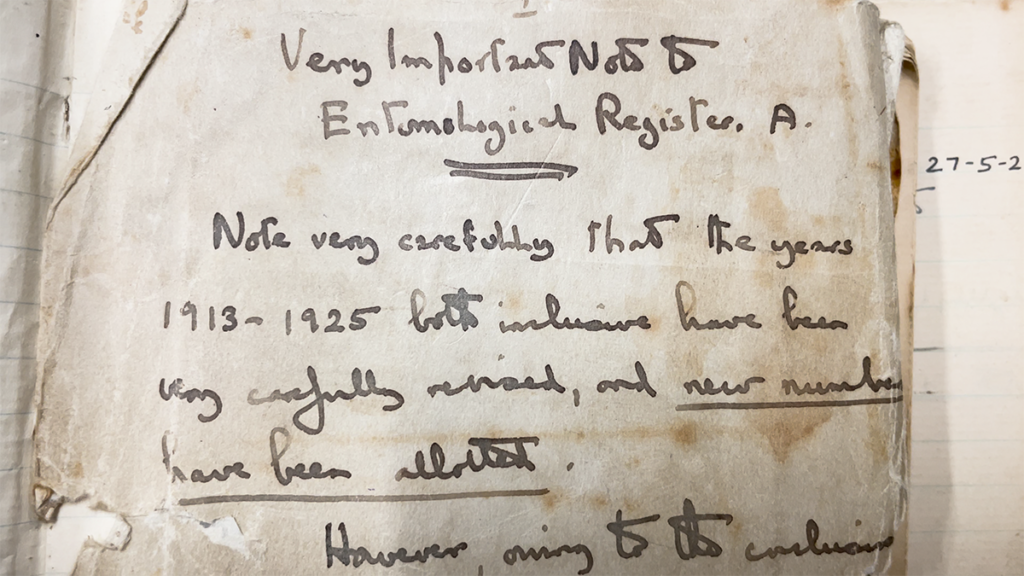
At Bristol Museum, a tray full of Large Blues are neatly labelled up. Gloucestershire, Cornwall, Devon and Somerset. One, tinged more purple catches the eye. The entomological register of I. R. P. Heslop captures our attention. Along with his contemporaries, he has numbered nature beginning in 1919. As Ray Barnett says, mostly people threw these journals away, although they donated the butterflies to the local museum when the collector died.
An outcome of Large Blue and the process of making the film has been to open our eyes to the fact that there are many interventions occurring across the butterfly world. In aspect, it is a small part of the story but opens up wider debates. Who has agency to tinker with species, locations, nature and the planet? Is this kind of thing best served by ‘legitimate’ conservation organisations and groups. What about renegade ‘introductionists’ who take it upon themselves to introduce butterflies in Croydon or Northants?
One final observation is where do the new conservations arise from? The next batch of custodians, gatherers and galavanters.
In a conversation towards the end of making the film we agreed that the way we had worked on this had more application elsewhere. So, we are going to carry on, in some form. An outcome from Large Blue has been to consider the idea of ‘complex systems’ and how we might apply the research and success at Collard Hill elsewhere.
‘Large Blue’ was shown at The Watershed, Bristol in 2023; as part of Wildscreen, Bristol in 2024; and at Bristol Art Gallery and Museum in 2024.